11 Early Signs You Have a Male Cannabis Plant
10 min read · , updated May 14, 2026
One undetected male plant can seed an entire crop in under 48 hours. For Canadian growers working under the Cannabis Act's four-plant personal limit, that's not an abstract risk — it's the difference between a jar full of potent, resinous sinsemilla and a harvest of seedy, low-THC disappointment. Learning to read the early signals of a male cannabis plant is one of the highest-value skills you can develop, and the good news is that the signs, once you know them, are surprisingly readable.
This is especially relevant if you're growing from regular (non-feminized) seeds. Roughly half of any regular-seed batch will be male. Spotting them before a single pollen sac opens is the mission.
Why Sex Identification Matters So Much
Cannabis is a dioecious plant — meaning individual plants are either male or female, not both (hermaphrodites are a special case we'll touch on). Female plants produce the cannabinoid-rich, terpene-dense flower that you're cultivating for. Males produce pollen sacs that, once open, broadcast fine pollen across every nearby female, triggering seed production and halting resin development almost immediately.
The practical consequences are severe:
- Seeded buds contain dramatically lower THC and CBD by dry weight — the plant redirects energy into seed maturation rather than trichome production.
- A single open male can pollinate every female in a 10 × 10-metre greenhouse through passive airflow.
- Yield per plant drops sharply — sometimes by 30–50% — when pollination occurs mid-flower.
- Curing quality suffers; seeds rupture trichome heads and add harsh, undesirable flavour compounds.
The solution is early identification and immediate removal. Here are all eleven signs, explained with enough detail to act on them confidently.
The 11 Early Signs of a Male Cannabis Plant
1. Pollen Sacs Instead of Pistils
This is the gold-standard indicator — the one sign that, on its own, settles the question definitively.
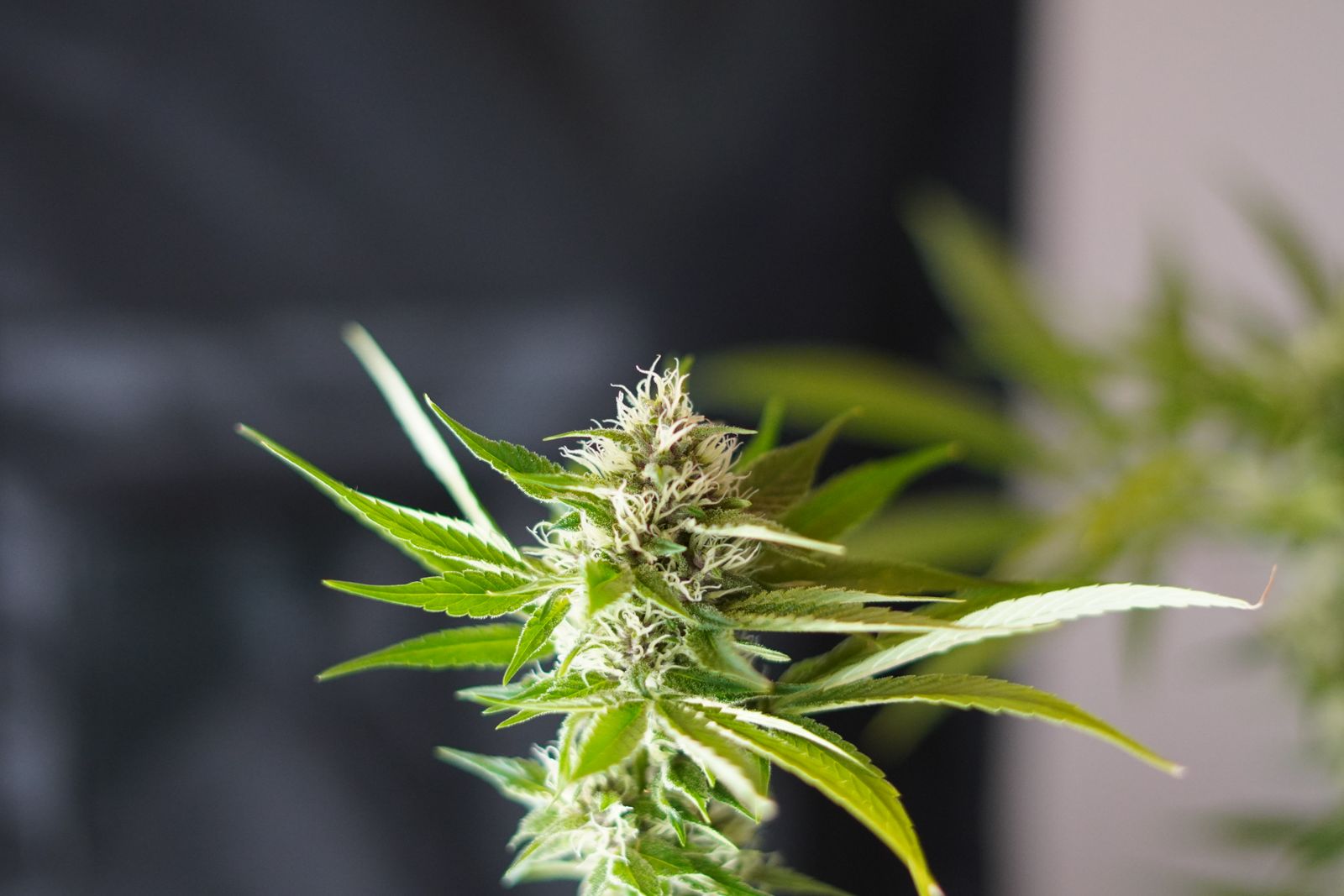
Examine the nodes: the points where branches meet the main stem. On a female plant, you'll see a teardrop-shaped calyx with one or two fine white hairs — pistils, emerging from its tip. On a male, you'll see a smooth, round, grape-like sac on a short stalk. No hairs. No fuzz. Just a tiny green or pale-yellow sphere.
Under a 30× jeweller's loupe, the difference is unmistakable. Even with the naked eye, once you've seen both side-by-side, you won't confuse them again. The sacs start small — barely 1–2 mm, but cluster rapidly. When they begin to swell and take on a slightly yellowish hue, opening is imminent. Remove the plant immediately.
2. Earlier Pre-Flower Timing
Males reveal their sex before females do. This is biologically deliberate: a male that matures first can release pollen just as females enter their receptive pre-flower window, maximising fertilisation success.
In practice, during the vegetative stage — roughly three to four weeks in, males will begin showing the earliest pre-flower structures at the nodes. Females typically lag by one to two weeks. So if one plant in your batch is showing any reproductive development noticeably ahead of the others, treat that as a red flag worth investigating daily.
This timing advantage is your greatest ally. Catch a male at pre-flower and you remove it before a single grain of pollen has been produced.
3. Faster Overall Maturation Timeline
Linked to the timing point above, but distinct enough to list separately. Males don't just pre-flower earlier — they reach structural maturity faster across the board. Internode spacing compresses, the plant stops adding significant vegetative mass, and it pivots toward reproductive output within a shorter timeframe than its female counterparts.
Watch the pace. A plant that seems to be "done" with vegetative growth and moving on while its neighbours are still pushing new leaf sets is worth flagging. Combined with any node-level structures, that accelerated pace is highly diagnostic.
4. Taller, Thinner Stature
Stand back and look at your garden from a distance. Male plants are consistently taller and more slender than females of the same age and genetics. They invest their energy in vertical reach — getting their pollen up high where air currents can carry it, rather than in lateral branching and dense foliage.
Compare a suspected male against your female-presenting plants side-by-side:
- Female: shorter, wider, bushier, more uniform canopy
- Male: taller, narrower, with longer internodal spacing and a more open silhouette
This visual contrast is easier to spot outdoors or in a large tent where you can observe plants at the same developmental stage simultaneously. In a dense indoor grow, check height relative to neighbours planted on the same date.
5. Fewer Leaves and Less Bushiness
Male cannabis plants are noticeably less foliar-dense than females. Their leaves are fewer, lighter in colour in some phenotypes, and spaced more loosely along the stem. They don't fill out laterally the way a healthy female does during the vegetative stage.
This sparse, airy look is a secondary indicator — not conclusive alone, since environmental stress can also reduce leaf density, but when you see an open, thin-foliage plant that's also taller than its neighbours and showing early node structures, the picture becomes clear.
6. Stronger Stems and Thicker Branches
Here's a counterintuitive one. Despite having fewer leaves and less overall mass, male plants often develop notably thick, stiff main stems and robust primary branches. This is structural support for a tall, wind-exposed pollen-dispersal architecture — the plant is building a broadcast tower.
Run your hand along the main stem. A male's stem will often feel woodier and more rigid at the same age as a female. The diameter is wider relative to its height. If you're doing any low-stress training (LST) and one plant feels unusually stiff and resistant to bending compared to others of the same strain, note it.
7. Fewer Branches and Simpler Architecture
Female cannabis plants during vegetative growth produce abundant lateral branching — this is the architecture that, when trained with SCROG nets or topped aggressively, yields enormous canopy coverage and multiple bud sites. Males, pursuing a different reproductive strategy, tend to grow with a simplified branching structure: one dominant main stem with modest lateral offshoots.
If a plant in your batch isn't responding to topping the way you'd expect — showing limited lateral explosion and instead just pushing straight up, that simplified growth habit deserves a close node inspection.
8. Early Ball Clusters at the Nodes
Pollen sacs rarely appear alone. They form in clusters at each node, resembling tiny bunches of grapes — smooth, round, and tightly packed. In some vigorous males, these clusters develop rapidly: you may see a single sac one morning and a cluster of five or six by the next evening under warm, high-intensity conditions.
The cluster formation can begin as early as three weeks into the growth cycle under 18/6 indoor lighting or during long summer days outdoors. Once the sacs swell visibly and the surface transitions from firm and green to slightly translucent or yellowish, dehiscence — pollen release, is hours away, not days. At that point, remove the plant wearing gloves and bag it before moving it through your grow space.
9. Absence of Pistils After Week Four or Five
By weeks four to five of the growth cycle, female plants will show unmistakable white pistils at the nodes — fine, hair-like strands emerging from a pointed calyx. These are the stigmata that catch airborne pollen in nature, and they're the grower's clearest visual confirmation of a female.
If your plant is past week four, growing vigorously, and showing zero white hairs at the nodes while displaying rounded structures instead, it's almost male. Don't wait for a sixth week of confirmation. The absence of pistils at this stage, combined with rounded node structures, is highly reliable evidence.
10. Minimal Trichome Development
Trichomes — the resinous glands that produce cannabinoids and terpenes, develop on female flowers, calyxes, and surrounding leaves in significant quantity as the plant matures. A healthy female in late veg or early pre-flower will show a light frosting under light, especially on younger growth near the apex.
Males produce trichomes in far smaller concentrations. The surface of a male plant looks relatively matte compared to a female's increasingly crystalline appearance. Under a loupe, female leaf tissue will show a scattered but definite glandular trichome population; male tissue will look comparatively bare. This is why male plant material has negligible potency — the biochemical machinery for cannabinoid synthesis is underdeveloped.
11. Noticeably Reduced Aroma
Terpene production and trichome density are closely linked, so it follows that males also smell less. During weeks three through five, female plants — even well before flowering, begin producing the characteristic terpene signature of their genetics. An OG-type female will hint at fuel and earth. A fruity hybrid will give off subtle citrus or berry notes.
A male plant at the same stage smells comparatively mild: faintly green, faintly grassy, without the complex aromatic depth that developing trichomes deliver. If one plant in your space seems "odourless" compared to its neighbours, that's worth combining with other visual checks.
How to Use These Signs Together
No single indicator below sign #1 (pollen sacs) is definitive on its own. Environmental stress, poor nutrition, or unusual phenotype expression can mimic individual traits. The method that works is triangulation: stack the signals.
- Start with node inspection — use a loupe under good light, check every node from the base upward.
- Check height and stature relative to siblings — is this plant taller, thinner, woodier?
- Assess timing — is this plant ahead of the others in showing any reproductive structures?
- Check for pistils — after week four, absence of white hairs is strongly indicative.
- Assess aroma and surface texture — less smell, less frost than comparable plants?
- Look at branching architecture — simpler, more vertical, fewer lateral offshoots?
If a plant scores positively on three or more of these checks, treat it as male and remove it. Don't gamble an entire female crop on a week of extra confirmation.
What to Do the Moment You Identify a Male
Act immediately — but act carefully. An open or partially open pollen sac releases millions of pollen grains, and those grains travel on clothing, hands, and air movement. Here's the removal protocol:
- Do not disturb the plant's canopy unnecessarily before removal.
- Minimise airflow — turn off fans before handling.
- Wear gloves and dedicate a set of clothes to the task if pollen sacs have already opened.
- Bag the plant at the base before pulling it — slide a large garbage bag over the top and tie at the stem.
- Remove the bagged plant from the grow space before cutting the stem or disposing.
- Clean the area and wash down any surfaces that may have received pollen.
In a greenhouse setting, this discipline matters even more. Pollen suspended in warm, humid greenhouse air can remain viable for hours. A single male that opens while you're away for a weekend can pollinate every female in the structure.
The Long-Term Solution: Feminized Seeds
The most reliable way to eliminate the male-detection problem entirely is to start with feminized seeds. Feminized genetics are bred to produce virtually 100% female plants, removing the identification challenge and the risk altogether. For Canadian home growers with a strict four-plant limit under the Cannabis Act, every plant slot is precious — using feminized seeds means every plant contributes to your harvest.
That said, regular seeds remain valuable for breeders, for growers exploring landrace or heirloom genetics, and for anyone who wants the full biological experience of cannabis cultivation. The skills covered in this article — reading plant structure, checking nodes daily, triangulating signs, are irreplaceable knowledge for anyone who works with regular seed stock.
For further cultivation guidance, explore our Marjiuana Education resource library, where Pacific Seed Bank's growing guides cover everything from germination through to harvest and cure.
The Skill Compounds With Every Grow
The first time you pull a male, you might second-guess yourself for a moment. By the third or fourth grow, the silhouette of a male plant — taller, thinner, woodier, ahead of schedule, with those unmistakable ball clusters at the nodes, will register before you've even reached for a loupe.
That pattern recognition is worth building deliberately. Keep a grow journal. Photograph nodes at week three and again at week four. Compare plants side by side. The growers who rarely get caught by an accidental pollination aren't lucky — they're observant. They've trained themselves to check nodes the way a mechanic listens to an engine: instinctively, daily, and with a clear mental picture of what "wrong" sounds like.
Your cannabis garden rewards that kind of attention with exactly what you're growing for: heavy, resinous, aromatic, sinsemilla flower — untouched by pollen, fully expressing the genetics you chose, and completely yours to harvest at peak ripeness.
Keep Reading
Do Pot Seeds Go Bad? The Real Scoop on Seed Shelf Life
Do pot seeds go bad? Yup. Find out how long cannabis seeds last, how to spot bad ones, and the best storage tricks to keep your seeds viable for years.
Cannabis Terms Explained: Vocabulary For New Growers
Cannabis Seed Storage Tips for Maximum Shelf Life