These People Love Cannabis So Much They Got It Tattooed
7 min read · , updated May 14, 2026
A quality full-sleeve can run upward of $3,000 CAD and take years to complete. The fact that thousands of people are choosing to permanently dedicate a portion of that real estate to cannabis says something loud and clear about where the plant sits in modern culture — not as a guilty secret, but as a genuine identity marker.
What's the Deal With Marijuana Tattoos?
Tattoos, when executed with skill and intention, are neither cheap nor reversible. That's precisely what makes the sheer volume of cannabis-inspired ink so fascinating. Walk through any major Canadian city — Vancouver, Toronto, Montréal, and you'll spot them: a serrated weed leaf inked along a forearm, a trichome-dusted nug rendered in photorealistic colour on a calf, a stylised seven-point fan tucked behind an ear. For some, it's pure aesthetic. For others, it's cultural declaration. For the most devoted growers and connoisseurs, it's a love letter to the plant itself.
What started as an adolescent act of rebellion — the tattoo in general, not cannabis specifically, has evolved into serious art and serious investment. I've personally spent more hours in a tattoo chair than I care to count, and I understand the ritual: the consultation, the sketch revisions, the adrenaline before the needle drops. Choosing cannabis as your subject adds one more layer of consideration, because the imagery is instantly recognisable and, depending on your workplace or social circle, carries weight beyond aesthetics.
So let's look at who's doing it well, what makes a cannabis tattoo genuinely excellent, and how to think about the decision before you commit.
Instagram's Best Marijuana Tattoos
The global tattoo community on Instagram is enormous, and cannabis-themed work spans every conceivable style — from hyper-realistic botanical illustration to neo-traditional cartoon characters to minimalist fine-line outlines. The pieces that stop the scroll share one quality: the cannabis element enhances the overall concept rather than screaming for attention on its own.
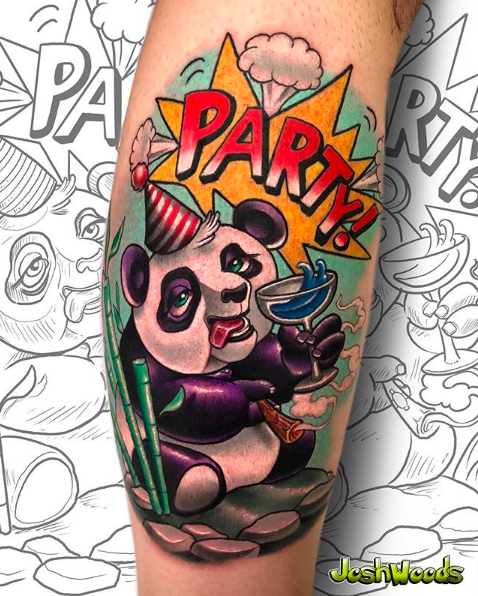
The Party Panda by Josh Woods. A panda smoking a blunt and sipping a cocktail is, objectively, a perfect tattoo concept. Artist Josh Woods executed it beautifully — the blunt is almost incidental, a prop rather than the punchline, and the placement on the leg means a pair of trousers renders it invisible in any professional setting. This is the gold standard for cannabis ink: the subject is unmistakable to fellow enthusiasts, but subtle enough that it doesn't define you to everyone else in the room.
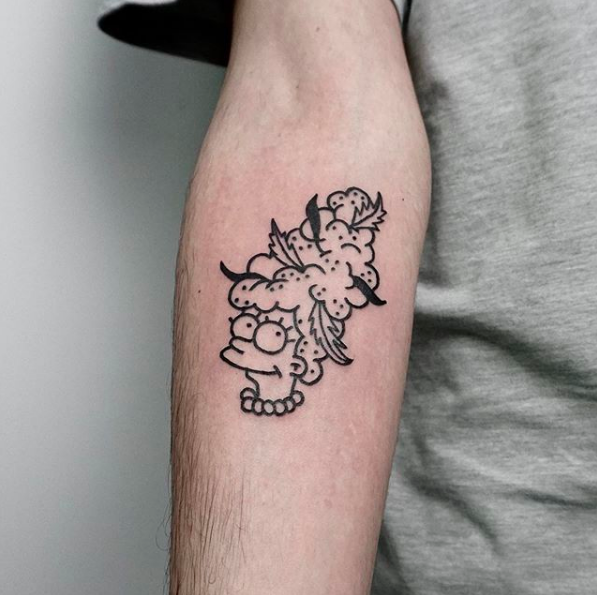
Marge Simpson with a Nug for Hair by Wiki_Mouse_Tattoo. Warsaw-based artist Wiki_Mouse_Tattoo replaced Marge Simpson's iconic blue bouffant with a dense, resin-heavy cannabis bud, and the result is inspired. Done entirely in black ink — no green, no obvious cannabis colouring, it reads as Marge at a casual glance. Only a second look reveals the joke. Placement on the upper arm keeps it easily covered by a long-sleeve shirt, which matters more than people admit when they're sitting across from a hiring manager or a grandmother at Thanksgiving dinner. The restraint in the colour palette is what elevates this from novelty to genuine art.
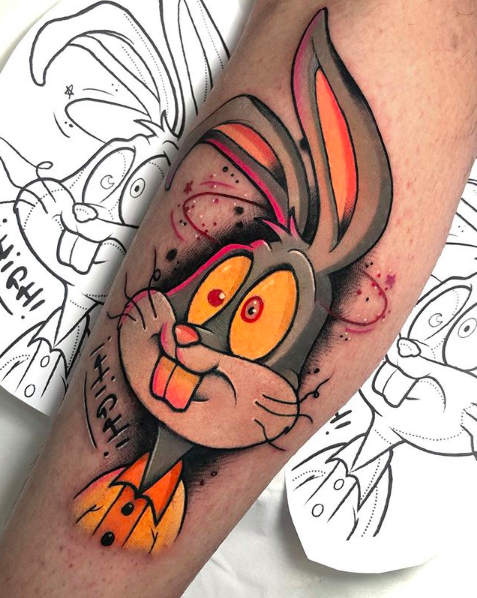
Stoned Bugs Bunny by Yerat Perez. Barcelona-based Yerat Perez works in vivid, saturated colour with the clean linework of classic American traditional, and his stoned Bugs Bunny is a masterclass in layered meaning. The piece says "High" rather than "Hi" — a single-letter swap that rewards the attentive viewer. Bugs looks a little strung out and "out of it", but honestly, Looney Toons characters always look a little unhinged. That's the genius of the concept: the cannabis reference is hiding in plain sight, perfectly camouflaged by the character's inherent absurdity.
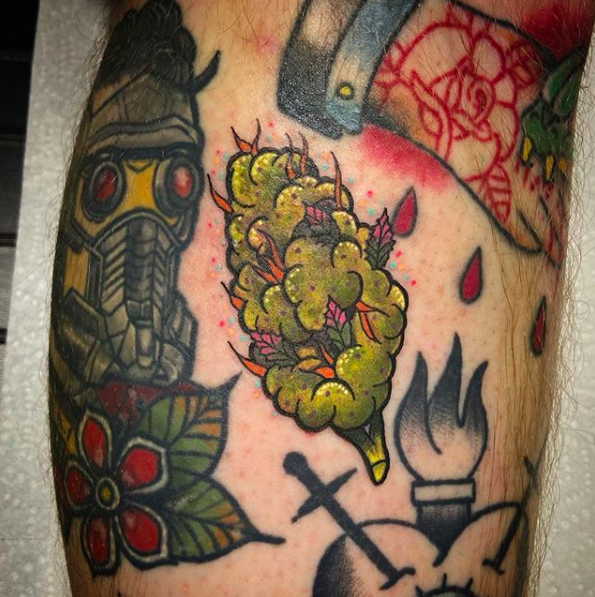
Photorealistic Nug by Jessica Sheyenne. In a field still heavily dominated by men, Jessica Sheyenne's small-scale colour work is worth seeking out specifically. Her photorealistic cannabis bud — bright amber pistils curling over deep green calyxes, a dusting of crystalline trichomes rendered with what looks like fine-point brushwork, is so lifelike it's almost uncomfortable to look at. You want to reach into the screen. I found myself wondering which strain she drew inspiration from; those fiery orange hairs and deep jewel-toned calyxes are reminiscent of something from the Purple family, strains known for their dramatic anthocyanin colouration and dense, resin-loaded structure. Whether the reference was intentional or intuitive, the botanical accuracy makes this piece extraordinary.
What Separates a Great Cannabis Tattoo from a Regrettable One
The difference between a tattoo you'll be proud of in twenty years and one you'll spend money covering up comes down to a handful of decisions made before the needle touches skin.
The single most important variable is the artist. Not your most tattooed friend. Not the studio offering a flash-day discount. Not the apprentice who'll do it cheaply as practise. The difference in outcome between a $150 piece and a $600 piece is not marginal — it is dramatic and permanent. A skilled artist brings not just technical execution but compositional instincts: how to balance negative space, how ink will spread and age in a given location, how to translate a reference image into something that will still read clearly in fifteen years when the skin has changed.
Here's a practical process for commissioning a cannabis tattoo you'll actually love:
- Research artists on Instagram and Pinterest, filtering by style — fine-line botanical work, neo-traditional, realism, and blackwork all render cannabis imagery very differently.
- Save a folder of reference images: both cannabis-specific inspiration and examples of the artist's existing work you want to emulate.
- Contact the artist via email or their booking platform with a clear brief — subject, approximate size, placement, and colour preferences — but explicitly invite their creative input.
- Attend a consultation in person if possible; this is where you'll determine whether the artist's sensibility and yours are aligned.
- Agree on placement, size, and colour palette, then confirm the deposit to hold your appointment.
Style matters as much as subject. A photorealistic nug like Jessica Sheyenne's requires an artist with a background in portraiture or botanical illustration. A graphic, flat-colour piece like Yerat Perez's Bugs Bunny calls for someone with strong traditional training and confident linework. Matching your concept to an artist who genuinely excels in that style is non-negotiable.
The Placement Question: Visibility, Context, and Canada's Cannabis Reality
Cannabis has been legal across Canada under the Cannabis Act since October 2018, and culturally, attitudes have shifted meaningfully since then. But legal doesn't mean universally accepted. A leaf tattooed on the side of your neck reads very differently in a craft brewery in East Vancouver than it does walking into a Bay Street boardroom, a federal government interview, or your partner's family dinner.
This is worth thinking through honestly — not because cannabis is shameful, but because context is everything.
- High-visibility placements (hands, neck, face, lower forearm): permanent social statements that cannot be neutralised by clothing. Choose these only if you're genuinely comfortable with every professional and personal audience seeing them indefinitely.
- Mid-visibility placements (upper arm, outer forearm, calf): coverable with standard professional attire, visible in casual or social settings. The sweet spot for most people.
- Low-visibility placements (upper back, ribcage, thigh, upper chest): private unless you choose to reveal them. Maximum flexibility, minimal professional risk.
- Fine-line and black-ink work: as the Marge Simpson piece demonstrates, removing obvious colour cues — specifically green — creates genuine ambiguity. To the uninitiated, a black botanical leaf tattoo might simply look like an interesting plant. That ambiguity is a design tool worth considering.
I'll be honest with you: I once impulsively got a matching taco tattoo with my best friend at midnight, and I have no regrets. But a cannabis tattoo is a different calculation — not because of stigma around the plant itself, but because the imagery is so instantly legible. A taco reads as "this person likes tacos." A cannabis leaf reads as "this person has a relationship with cannabis," and people will draw their own conclusions from there. You can own that completely, or you can be strategic about when and where you reveal it. Neither choice is wrong.
Cannabis Culture Has Always Left Its Mark
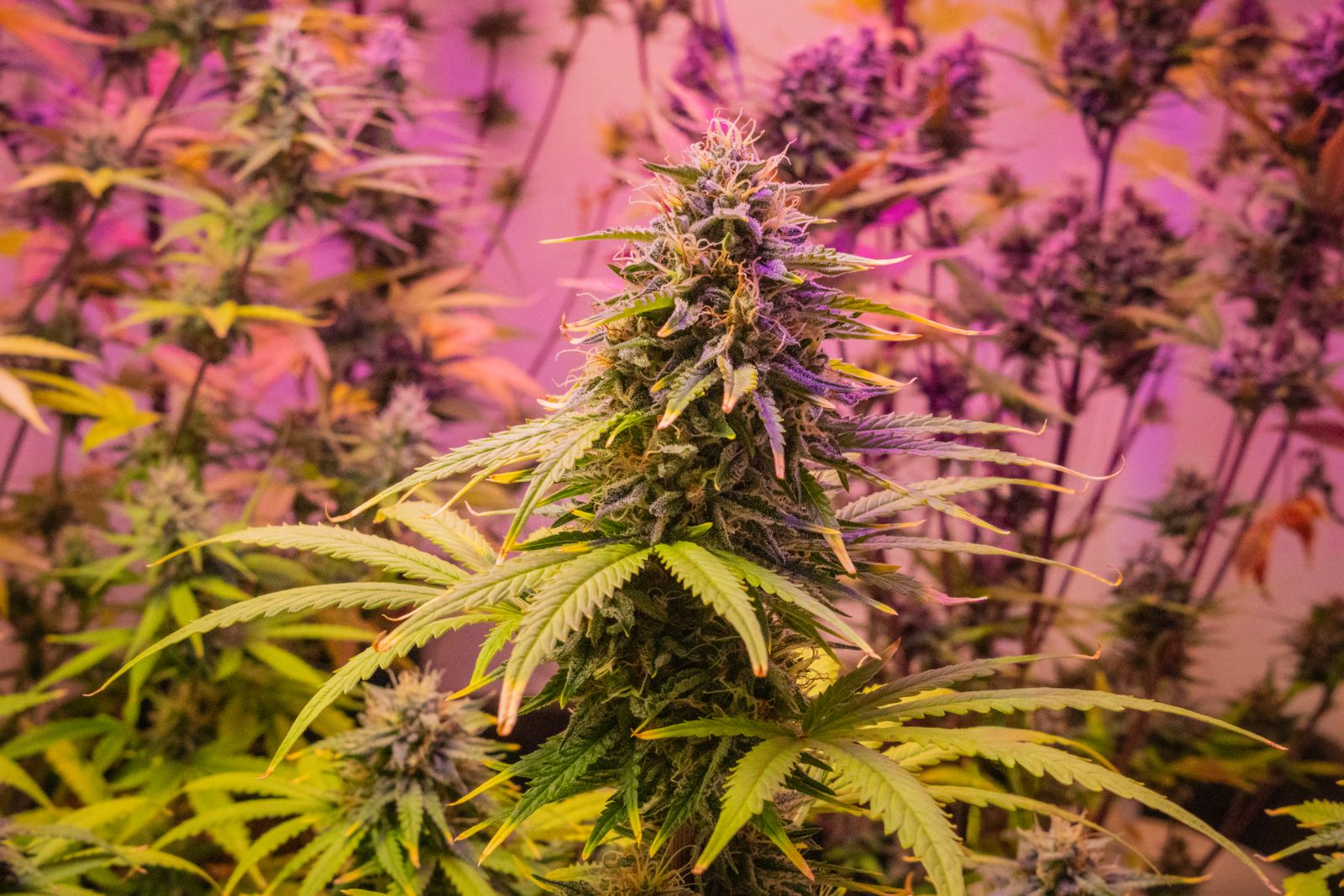
There's something genuinely moving about the botanical specificity in the best cannabis tattoos — the way a skilled artist captures the asymmetry of a fan leaf, the way trichomes catch light differently at different angles, the particular droop of a fully matured cola heavy with resin. Growers recognise these details immediately. They're the same details you're watching for in the final weeks of flower, the same cues you're assessing when you decide whether another five days on the plant will deepen the amber in those trichomes or push you past the window.
That knowledge — hard-won through seasons of growing, reading, and paying attention, is part of what makes cannabis culture worth celebrating in the first place. Tattoos are one expression of that celebration. The seeds you choose, the cultivars you bring to harvest, the way you talk about terpene profiles and phenotype expression with people who care, those are others.
For more on the culture, the lifestyle, and everything that goes along with loving this plant, explore our Marijuana Lifestyle section. Whether you're deep into cultivation or simply passionate about cannabis as a part of your daily life, there's no shortage of ways to wear that passion — ink optional.