Queen Victoria used it. Ancient herbalists prescribed it. And today, a growing number of Canadian women are reaching for cannabis before they reach for ibuprofen. The relationship between marijuana and the menstrual cycle is older than modern medicine — yet science is only now beginning to map the biochemical reasons why it works.
With cannabis legalization maturing across Canada and the broader Americas, researchers have gained meaningful access to study the endocannabinoid system (ECS) and its surprisingly intimate role in reproductive health. What they're finding is that the ECS doesn't just tolerate cannabinoids — it actively participates in the hormonal processes that govern the menstrual cycle. That's a significant discovery, and it reframes cannabis not as a folk remedy but as a physiologically logical tool.
Here's what the evidence — and centuries of lived experience, actually tell us.
Cannabis, Cramps, and the Endocannabinoid System
Period cramps, clinically called dysmenorrhoea, are caused by uterine contractions triggered by prostaglandins — inflammatory compounds released as the uterine lining sheds. The severity varies enormously between individuals, but for many women, cramping is genuinely debilitating rather than merely uncomfortable.
Cannabis has been documented as a menstrual remedy across cultures for millennia. Ayurvedic texts reference it. Chinese imperial medicine catalogued it. And yes, Queen Victoria's personal physician, Sir J. Russell Reynolds, reportedly prescribed cannabis tincture to the monarch for menstrual pain — a detail so specific it demands attention. This isn't vague folk wisdom; it's a cross-cultural pattern pointing to a real mechanism.
That mechanism lives inside the endocannabinoid system. CB1 and CB2 receptors are distributed throughout uterine tissue, and both THC and CBD interact with pathways that modulate prostaglandin production and inflammatory signalling. CBD, in particular, is a well-documented anti-inflammatory that inhibits COX enzymes — the same target as ibuprofen, though through a different molecular route. For women seeking relief without the gastrointestinal side effects of NSAIDs, a high-CBD cultivar represents a genuinely compelling alternative.
Formal randomised controlled trials on cannabis and dysmenorrhoea remain limited as of this writing — regulatory barriers historically made that research difficult, but the biological plausibility is strong, and self-reported relief is consistent across user populations. The absence of a clinical trial does not mean the absence of effect; it means the research infrastructure is catching up to thousands of years of practice.
For cramp-focused relief, consider cultivars that balance CBD alongside moderate THC — enough cannabidiol to address the inflammatory component, with THC contributing muscle-relaxant and analgesic effects. A 1:1 CBD:THC ratio is a reasonable starting point for daytime use, while an indica-leaning evening strain may provide deeper physical ease without disrupting the next morning.
Premenstrual Syndrome: What's Actually Happening Hormonally
PMS is not a mood. It is a hormone event.
In the luteal phase — the days between ovulation and menstruation, progesterone climbs sharply while oestrogen begins its descent. This hormonal shift affects serotonin production, GABA receptor sensitivity, and cortisol regulation simultaneously. The result, for many women, is a cluster of symptoms that can arrive anywhere from two to ten days before bleeding begins.
The most commonly reported PMS symptoms include:
- Bloating driven by water retention and gut motility changes
- Cramps that can begin before menstruation itself starts
- Irritability and emotional lability tied to serotonin fluctuation
- Headaches and migraines, often correlating with the oestrogen drop
- Breast tenderness and lower-back ache
- Sleep disruption, which compounds every other symptom
Historically, physicians treated severe PMS with supplemental progesterone — a logical-sounding intervention that subsequent research showed to be largely ineffective. The problem is that PMS isn't simply a progesterone deficiency; it's the brain's sensitivity to the hormonal fluctuation itself. That distinction matters for understanding where cannabis fits.
The ECS acts as a regulatory buffer across multiple neurotransmitter systems, including the very serotonergic and GABAergic pathways disrupted by the luteal hormone swing. THC and CBD modulate 5-HT1A (serotonin) receptors and influence GABA tone — not by adding hormones to the system, but by supporting the neural architecture that processes hormonal signals. It's a fundamentally different intervention logic, and for some women, a more effective one.
Moodiness, Anxiety, and Cannabis as a Stabiliser
The emotional volatility that accompanies PMS and menstruation isn't weakness or irrationality — it's neurochemistry. Oestrogen supports serotonin synthesis and the density of serotonin receptors; when oestrogen drops in the days before a period, serotonin availability drops with it. Simultaneously, cortisol can spike, and the combination of lower serotonin and elevated cortisol is, quite simply, the biological recipe for anxiety, low mood, and irritability.
Cannabis interacts with this system at multiple points. THC activates CB1 receptors in the amygdala — the brain's threat-assessment centre, which can dampen the stress response at the source. CBD modulates the same serotonin receptors targeted by conventional anxiolytics, without the dependency profile. Together, or separately depending on the individual's preference and sensitivity, cannabinoids can take the edge off a hormonal mood spiral in ways that don't require a prescription.
The key is dosing with intention. Low to moderate THC — in the 10–15% range, tends to produce a calming, mood-lifting effect. Higher THC concentrations (above 20–22%) can paradoxically increase anxiety in sensitive individuals, particularly when oestrogen is already low and the brain's stress circuitry is primed. This is not a reason to avoid cannabis during PMS; it's a reason to select cultivars thoughtfully and consume with awareness.
Indica-dominant and balanced hybrid strains are generally better suited to the emotional dimension of PMS than high-sativa cultivars, which can amplify racing thoughts rather than quiet them. That said, individual phenotype expression and personal neurochemistry mean the best approach is always personal experimentation at conservative doses, moving incrementally.
Why You May Need More Cannabis During Your Period
If you're a regular cannabis consumer, you may have noticed — without necessarily understanding why, that the same dose that works perfectly in week two of your cycle feels underwhelming in the days before or during your period. This isn't tolerance creep. It's oestrogen.
Oestrogen levels peak around ovulation, and during that peak the enzyme FAAH (fatty acid amide hydrolase), which breaks down the body's own endocannabinoid anandamide, is suppressed. More anandamide circulating means the ECS is already running warmer, and exogenous THC has a more potent effect. As oestrogen falls in the luteal phase and during menstruation, FAAH activity increases, anandamide is broken down faster, and the same dose of THC produces a comparatively weaker effect because the baseline endocannabinoid tone is lower.
In practical terms: your body genuinely needs more cannabinoid input to reach the same therapeutic or experiential threshold during menstruation. This is not a sign of problematic tolerance; it's a physiologically predictable fluctuation driven by your hormonal cycle. Knowing this allows you to adjust your consumption strategy rather than wondering what changed.
A few practical calibration strategies:
- Track your cycle alongside your consumption. A simple journal — strain, dose, timing, symptoms — will reveal your personal pattern within two or three cycles.
- Micro-dose more frequently rather than taking larger single doses, particularly if anxiety is a PMS symptom. Smaller, more frequent doses maintain steadier ECS tone without overshooting.
- Consider shifting your cannabinoid ratio during menstruation — slightly higher THC or a broader-spectrum product — rather than simply consuming more of the same thing.
- Prioritise terpene profiles as much as cannabinoid percentages. Myrcene contributes muscle-relaxant effects useful for cramping; linalool adds anxiolytic tone; beta-caryophyllene, a CB2 agonist, targets peripheral inflammation directly.
- Stay hydrated and maintain electrolyte balance. Cannabis affects vasodilation and can mask thirst signals — both factors that interact with the bloating and headache components of PMS.
Choosing the Right Cultivar for Cycle-Based Relief
Not all cannabis is equal in this context, and the distinction between cultivar types matters practically.
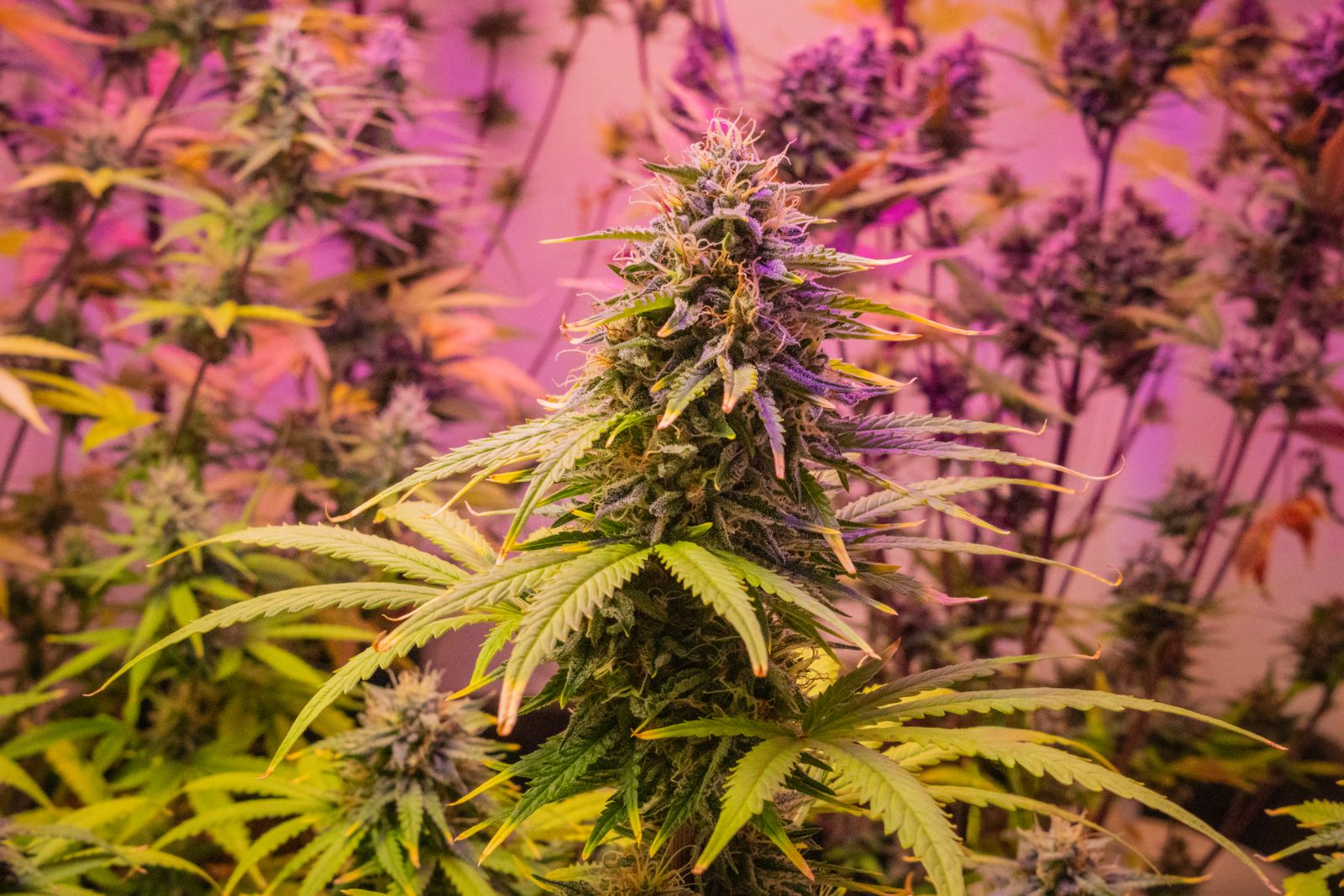
High-CBD feminised strains are the most versatile entry point for women new to cannabis-based menstrual support. The anti-inflammatory and anxiolytic properties of CBD operate without the psychoactivity of THC, making them appropriate for daytime use when cognitive clarity matters. For women who are managing workdays while dealing with cramps and mood fluctuation, a CBD-dominant strain is a meaningful tool rather than an impairment.
Indica-leaning feminised cultivars with moderate THC — in the 14–18% range, offer the deeper physical relaxation useful for evening cramping and the sleep disruption that PMS frequently causes. The body-centred effect profile of these strains pairs well with the muscle-contractile nature of dysmenorrhoea.
Autoflowering varieties deserve a mention for the practical grower who wants a personal supply on a predictable schedule. Their shorter seed-to-harvest timeline — typically 70 to 90 days from germination, means a cultivator can maintain a rotating stock of freshly cured flower without the longer vegetative commitment of photoperiod strains. For someone growing specifically to support their own wellness routine, that consistency has real value.
Balanced hybrids — 50/50 or close to it, offer the middle path: enough indica-character to address the physical symptoms and enough sativa lift to prevent the couch-lock that makes a difficult day harder. These are worth exploring for daytime cramping when energy is already depleted.
The Marijuana Lifestyle section of the Pacific Seed Bank blog covers cultivar selection, terpene profiles, and wellness applications in detail — a useful resource as you build out your understanding of which strains serve specific therapeutic contexts.
A Note on Safety, the Canadian Cannabis Act, and Reproductive Health
Canada's Cannabis Act provides adults with the legal framework to possess, purchase, and cultivate cannabis for personal use — up to four plants per household under federal law. That framework matters here because it means Canadians can make informed, legal choices about cannabis as part of their personal health toolkit without the legal precarity that complicates this conversation in other jurisdictions.
What the framework does not provide is clinical guidance, and that gap is worth naming honestly. If you are pregnant, trying to conceive, or breastfeeding, cannabis is not recommended — the ECS plays significant developmental roles in fetal and infant neurology, and no safe threshold of exposure has been established. If you are managing a diagnosed condition like endometriosis or PMDD (premenstrual dysphoric disorder), cannabis may complement, but should not replace, the care of a physician familiar with your history.
For healthy adults using cannabis to manage the normal, if uncomfortable, physiology of menstruation and PMS, the risk profile is well within the range of personal autonomy. Start low, go slow, keep notes, and adjust based on your own cycle's data.
Cannabis and the menstrual cycle share a biochemical intimacy that science is finally beginning to articulate clearly. The endocannabinoid system doesn't sit apart from reproductive physiology — it is woven through it, responsive to the same hormonal rhythms that drive the cycle itself. Understanding that relationship turns cannabis from a generic comfort measure into a precisely applicable tool: the right cultivar, the right ratio, the right timing within your cycle. That level of intentionality is where traditional plant wisdom and modern cultivar science meet, and it's a conversation worth having every month.